
Seedance 2.0 Fast Tier vs Standard: The Pricing Math
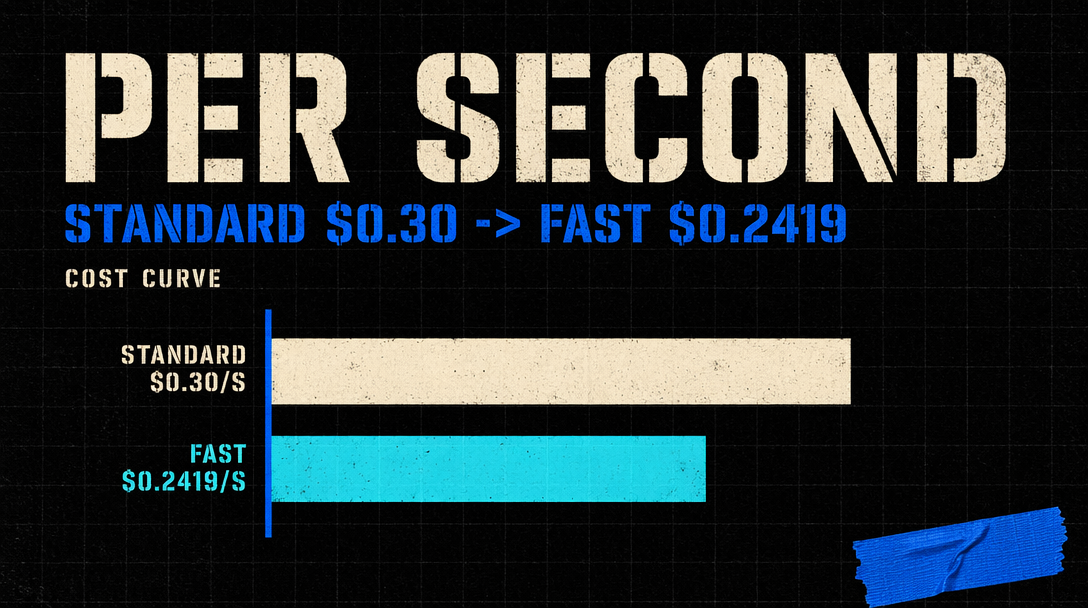
Standard T2V is $0.3034/sec, Fast is $0.2419/sec for roughly 20% off. Here is the token formula, a 100 clip budget table, and when Fast loses quality.
Seedance 2.0 has two tiers on fal: Standard and Fast. Same prompt surface, same 720p cap, same 4 to 15 second range. Fast trades some fine detail and narrative coherence for about 20% off the bill. This post runs the actual math.
The per second rates, spelled out
Text to video Standard: $0.3034 per second. Image to video Standard: $0.3024. Reference to video with image inputs: $0.3024. Reference to video with video inputs applies a 0.6 multiplier and lands at $0.1814 per second.
Fast tier text to video: $0.2419 per second. Fast reference to video with video input: $0.14515 per second. Fast drops token cost from $0.014 per 1K to $0.0112 per 1K.
The token formula you can put in a spreadsheet
Every Seedance 2.0 call bills tokens based on output dimensions, duration, and frame rate:
1tokens = (height x width x duration_seconds x 24) / 1024
At 720p (1280 x 720), 5 seconds, 24fps:
1(720 x 1280 x 5 x 24) / 1024 = 108,000 tokens
Standard: 108,000 x $0.014 / 1000 = $1.51. Per second rate ($0.3034 x 5 = $1.52) tracks the token math within rounding. Stick with per second for quick math.
The 100 clip budget table
100 ad variants, each 5 seconds at 720p:
| Scenario | Per clip | 100 clips | Delta |
|---|---|---|---|
| Standard T2V (5s, 720p) | $1.517 | $151.70 | baseline |
| Fast T2V (5s, 720p) | $1.2095 | $120.95 | save $30.75 |
| Standard I2V (5s, 720p) | $1.512 | $151.20 | save $0.50 vs T2V |
| Fast I2V (5s, 720p) | $1.2095 | $120.95 | save $30.25 |
Bump duration to 8 seconds: Standard lands at $242.72 for 100 clips, Fast at $193.52, saving $49.20.
A real production workflow with 3 to 5 iterations per final clip: 400 renders at 8 seconds is $970.88 Standard vs $774.08 Fast. The $196 difference is real money for a small studio.
Where Fast wins
- Early concept exploration. You don't know if the shot works yet. You want 20 angles cheap.
- Client reviews. Rough cut quality is fine for approval.
- Prompt sweeps. Varying wording across 50 calls to find the right phrase.
- Ad iteration. Testing 10 variants of the same 5 second hook on paid media, then re rendering the winner on Standard.
- Social drafts. TikTok and Reels compress hard enough that Fast often looks the same at playback.
Where Fast loses
- Fine texture work. Fabric weave, hair strand detail, reflective surfaces. Fast smooths these out.
- Long narrative continuity. 12 to 15 second single shots with multiple actions. Fast drifts on the second half.
- Complex physics. Water interactions, shattering glass, cloth simulation. Fast wobbles.
- Multi speaker dialogue with tight lip sync. Fast's audio is less polished.
- Hero shots for final delivery. Homepage or broadcast: render the winner at Standard.
The minimal Fast call
1import { fal } from "@fal-ai/client";23const result = await fal.subscribe("bytedance/seedance-2.0/fast/text-to-video", {4 input: {5 prompt: "Aerial shot over a coastal highway at sunset, one red convertible cutting through switchback curves, golden hour side light.",6 resolution: "720p",7 duration: 6,8 aspect_ratio: "16:9",9 generate_audio: true10 },11 logs: true12});1314console.log(result.data.video.url);15// 6 seconds at $0.2419 = $1.45 per clip
Same prompt on Standard lands at $1.82. For a driving shot at 6 seconds you probably cannot tell the difference on a phone screen. On a 4K desktop, side by side, Standard holds reflection detail better.
The iteration workflow most shops converge on
- Start every concept on Fast. Burn 10 to 20 calls to find the prompt.
- Once the prompt is locked, render 3 to 5 variations on Standard to pick a hero.
- If the hero has a motion issue, fix the prompt and re render on Standard only for the winner.
That pattern lands a finished clip for about $6 to $10 all in, versus $15 to $25 going Standard from the first prompt. Savings compound across a slate.